
November is Men’s Health Awareness Month, also known as Movember, so I wanted to take this opportunity to talk about some skin and scalp issues that predominantly affect men.
Rosacea in men
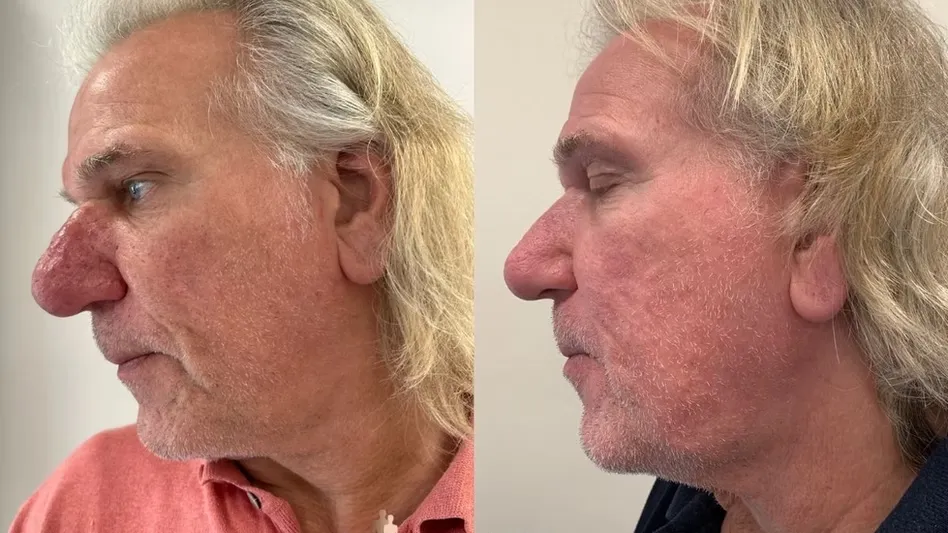
While rosacea in both men and women commonly appears on the cheeks, chin and forehead, for men it is more likely to affect the nose as well. This is called rhinophyma, and presents as a thickening and reddening of the skin on the nose, usually combined with an uneven, lumpy texture. It is unfortunate that this condition has – erroneously – been linked to excess alcohol consumption, leading many men to feel judged in addition to being self-conscious.
Treating folliculitis barbae and pseudo-folliculitis barbae
Folliculitis barbae is an inflammation of the hair follicles in the beard area. It is characterised by raised, red, itchy pustules around the chin and cheeks, and is often – but not always – caused by infection with the staphylococcus aureas bacterium. Because it is difficult to avoid cutting the pustules when shaving, the infection gets spread easily. In more severe cases, the condition can lead to scarring.
Acne Keloidalis nuchae affecting men
This is in effect similar to pseudo-folliculitis barbae, where close shaving in susceptible patients leads to ingrowing hairs and a foreign body inflammatory reaction. It is most common in men with skin of colour and/or men with curly hair.
Male acne
Acne affects both men and women – and in fact is more common in adult women than men, but the opposite is true in the teenage years when severe acne is very common in males. Male acne is also more likely to be severe on the back, neck and shoulders.
Commonly known as ‘backne’, this condition can be exacerbated by tight fitting clothes or backpacks that trap sweat next to the skin, and by excess sweating in occlusive wear, particularly during exercise. If men use anabolic steroids to help them gain muscle, it can lead to terrible acne.
While it is of course easier to hide acne on the back than on the face, the condition can still cause pain, discomfort and embarrassment, and many men suffering from backne are reluctant to go swimming or do other activities that might require them to remove their shirts in public.
Seborrheic dermatitis
More commonly affecting men than women, seborrheic dermatitis is a scaly rash that usually presents on the scalp, eyebrows, sides of the nose and chest. It is thought to be due to an inflammatory reaction to the yeasts that help to make up the normal flora of the skin. Although it is not entirely understood what causes some people to react to the yeasts in this way, the condition can be aggravated by stress, illness, fatigue, or heavy alcohol intake, and is much worse with immunodeficiency disorders. It is frequently seen in association with rosacea and with Parkinson’s disease.
Special considerations when treating the skin and scalp issues men face
As you can see, while men and women are often affected by the same conditions, these can present in very different ways, and sometimes need to be treated differently too. This difference also applies when we consider cosmetic treatments for men, such as:
Anti-wrinkle injections: men can be just as concerned about ageing as women, but the ways in which they want to treat that might differ. When using anti-wrinkle injections on men, for example, they often want to reduce the appearance of wrinkles on the forehead, but avoid an overly smooth, ‘feminised brow’. They’re also less likely to want an arched eyebrow. An experienced and advanced practitioner can achieve this through judicious placement of the correct amount of product.
Facial hair growth and laser treatment: one side effect of some laser treatments can be reduced hair growth in the treatment area. Of course, for women this is often an added bonus, but for male patients this is something that needs to be discussed in detail in the consultation phase.
Skin rejuvenation treatments: treatments like platelet rich plasma injections (PRP) and Polynucelotides can present a great anti-ageing option for men who would like to achieve a rejuvenated look without any tell-tale signs. These treatments stimulate the body’s own collagen-production process, which means your skin will get smoother and younger-looking gradually, without anyone noticing you’ve had anything ‘done’.
For more information or to book an appointment, please contact us.